Showing posts with label spirit-led. Show all posts

Friday, August 22, 2025

Song of Simeon (Nunc Dimittis) – Simeon


29 “Lord, now you are letting your servant depart in peace, according to your word; 30 for my eyes have seen your salvation 31that you have prepared in the presence of all peoples, 32 a light for revelation to the Gentiles, and for glory to your people Israel.”


You could say it was Simeon’s exclamation, and not just the mark one might make at the end of a sentence. This one was worth a whole life’s wait. (See here the 19th Century artwork Simeon the Righteous by Aleksey Yegorov.) The story of Joseph, Mary and their unique son Jesus began before He was even born, and four songs marked this unique occasion. Three other songs had already been sung because of events surrounding Jesus and his relatives. The first one was Mary’s song called the Magnificat (Glorifies, in Latin) when she visited her aged relative Elizabeth, and the baby inside Elizabeth rejoiced because he recognized Jesus even when He was still in the womb; the second one was the song of Zechariah (Elizabeth’s husband) and was called Benedictus (Praise Be, in Latin) and celebrated his son John the Baptist’s role as a prophet heralding/announcing the Messiah’s coming ministry and salvation; the third was the song Gloria in Excelsis Deo (Glory to God in the Highest, in Latin), which was the angels’ song announcing Jesus’ birth to shepherds; and the fourth was the song sung by this old man named Simeon. All four of those songs are in the first 2 chapters of Luke.


Joseph and Mary, though poor commoners, were doing what the Jewish law dictated, but also what the angel had told them to do, and they named the baby Jesus (Luke 1:31/Matthew 1:21; Jesus is the Greek form of the name that means Joshua [the Lord saves]). They traveled the five or six miles or so from Bethlehem north to Jerusalem to do what was required. Three distinct Jewish legal requirements they performed after naming Him were these: first, they had Him circumcised (the eighth day after birth, according to the law [Genesis 17:12; Leviticus 12:3); second, they waited until 40 days after Jesus’ birth (so, 33 days more), so that Mary could make an offering at the temple for her purification (Leviticus 12:4); and third, they had to offer Jesus, as the firstborn son, as a dedication to the Lord – what is known still today as Pidyon Haben (redemption of the firstborn son) – according to the ancient law (Exodus 13:2,12-15; Numbers 18:15-16). It was probably just before this Pidyon Haben that Joseph and Mary encountered the man named Simeon. Simeon was apparently a ‘devout’ man (Luke 2:25) whom the Spirit had moved to come into the temple courts (verses 26-27).  And he said something that he must have been wanting to say his whole life – that this baby was the source of salvation for all. That’s very important, because it is so strikingly reminiscent of what the prophet Isaiah had said about a servant centuries earlier (see Isaiah passages – 42:6 and 49:6). To be clear, Isaiah wasn’t necessarily looking ahead to a Messiah, but this Simeon was looking backward to what Isaiah had said, and through the Spirit that moved him, projected that that servant who would be a light and offer salvation for the Gentiles, and would be a glory to the Jews, would in fact be this baby he was holding. When Simeon said he was satisfied that he could now be dismissed and feel at peace, would it be too much of a stretch to say he was singing his own funeral’s song? What a way to conclude one’s life, not with a dirge, but with an exclamation of utter delight! Nunc Dimittis (in Latin) – Lord, you now dismiss!


 After Simeon had sung his song, Joseph and Mary marveled at what he’d said (verse 33) – very similar to Mary’s treasuring up things in her heart (verse 19) earlier, on the night Jesus was born. But then, Simeon told them some things that must have made them cringe, too – that Jesus was to be a source of clashes and controversy, and some heartache for them too (verses 34-35). Aren’t all children, even occasionally, sources of some anguish for parents? Where would an exceptional child from God rank on that heartache spectrum? An old prophetess named Anna, who stayed at the temple all the time, also was moved by Jesus’ presence, and told others about the redemption of the city. And so, no parents in history had more to ponder, nor felt more responsibility for a child in their care, than those two from Nazareth.


The above story details are all obtained via the NIV Study Bible and notes for the Luke 2 account of this episode.


See a well-done, pretty moving rendition of Simeon’s Exclamation here: Nunc Dimittis by Peter Wilkinson


See information on the artwork here: https://commons.wikimedia.org/wiki/File:Yegorov-Simeon_the_Righteous.jpg …This work is in the public domain in its country of origin and other countries and areas where the copyright term is the author's life plus 100 years or fewer. This work is in the public domain in the United States because it was published (or registered with the U.S. Copyright Office) before January 1, 1930.

Friday, January 17, 2025

Holy Spirit -- Keith Getty and Stuart Townend


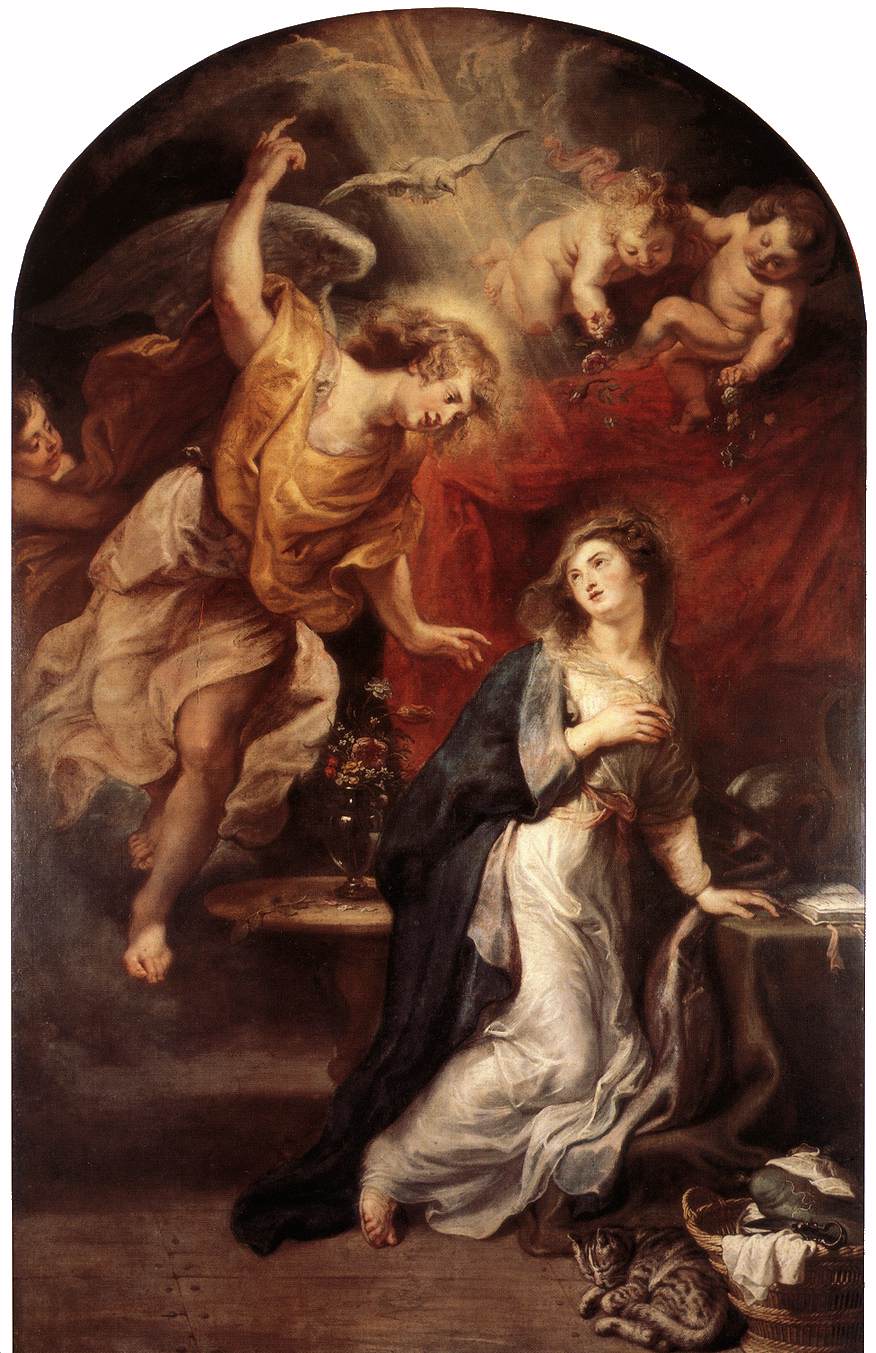
Have you ever been a signpost? Hopefully, a Christian could say ‘indeed, I am one everyday’. As a blogger about the songs we sing, I offer one here today for your consideration without much commentary by me, because it is unnecessary. Keith Getty and Stuart Townend have provided every explanation that we could hope for in their 2005 prayer-song that addresses perhaps the Godhead’s least recognized person – the “Holy Spirit”. (See here the angel Gabriel telling Mary that she would give birth to Jesus through the Holy Spirit descending on her as a dove in beams of light, in the 17th Century masterpiece artwork Annunciation by Peter Paul Rubens.) I’m just pointing you, the reader, to this online published story; and, Keith’s account tells us that he and Stuart were, in their own way, trying to be signposts, too. So, see below for what Keith says about “Holy Spirt”, in italics (or see one of the two links to his words below.)

“Holy Spirit” is the final hymn I wrote with Stuart Townend as part of the 'Apostle’s Creed' album we created in 2005. This collection of songs focuses on the basic tenants of the Christian faith outlined in the ancient creed.

As in much of our songwriting, we wanted to connect the radical truths of what we believe with everyday life. In this particular song, we desired the hymn to function as a sung prayer about the Holy Spirit’s renewing power. In church services, it works well used just prior to the sermon or at its conclusion, as well as before the service or during a prayer time.

We divided the hymn into three verses. The first expresses a prayer for inward change, asking the Holy Spirit to transform us from the core of our being. Without such change, all religious attempts are futile. We must daily ask for renewal and the desire to love and treasure God’s word and his ways.

Verse two petitions the Spirit to abide in us so we’re able to bountifully bear His fruit, such as the kindness and gentleness described so beautifully in Galatians 5:22-23. Closing this verse is a prayer “to show Christ is all I do.”

Verse three is a more expansive prayer for the church. During the songwriting process, we kept revisiting this verse as we examined the role of the Holy Spirit throughout the New Testament. In passage after passage, evidence of the Holy Spirit’s power in someone’s life was marked by two characteristics--Christ is magnified, and the individual is led on a path of sacrifice.

We thus combined the lyric and arrangement of the last verse to build through the first five lines as we convey the power of the Spirit and our desire to see the church hunger for His ways. Then in line six, we suddenly stop with the prayer, “Lead us on the road to sacrifice/ That in unity the face of Christ/ Will be clear for all the world to see.” Artistically, this works as a bit of a surprise as we underscore the paradox and wonder of Christ’s power in us. Only through experiencing sacrifice are we unified as the body of Christ. Only through reaching the end of ourselves can we achieve a vibrant Christian witness that everyone on the outside can see as different. 

Keith Getty

 See this link for story:  The Story Behind the Song Holy Spirit | PraiseCharts


See the story here also: Holy Spirit, Breath of God - Getty/Townend Hymn - Worship Matters


See information on the masterpiece artwork here: Peter_Paul_Rubens_-_Annunciation_-_WGA20250.jpg (876×1353)…. This work is in the public domain in its country of origin and other countries and areas where the copyright term is the author's life plus 100 years or fewer. {{PD-1996}} – public domain in its source country on January 1, 1996 and in the United States.

Thursday, June 8, 2023

If You Say Go -- Diane Thiel-Sharp


Her own words have echoed deeply and broadly as the years have mounted up, and as life experiences have engulfed her. But, could Diane Thiel (she’s since remarried Rod Sharp) have reasonably perceived that what was going on in Chicago (see its seal here) in the 1990s would have meaning for her some two decades later? She believed – and still does – that the Holy Spirit had her say “If You Say Go” once upon a time. That little phrase compelled her and her family to make an emotional move, away from a place and people that they loved, and into another life-stage where it seemed one trouble after another beset her. ‘Why?’, she might have cried out in aggravation, except that her disposition was to follow Him, no matter what. That’s what has helped her see, with patience and devotion, how that little song-title has taken on multiple meanings, and filled out her days with appreciation for how He works in unexpected ways. ‘Amazing’, she would probably admit.


It all began in her car, as she recalls what she was doing in the Chicago area, sometime before 1997. In a podcast (see its link below), Diane reminisces that she felt an overflow, and a response to what was happening in her life – that it was a desperation to love God wholly, to want what He wanted, and that this came from a life of passion and joy. She says that this steadfastness also later connected with people in difficult circumstances. The song just came over her, such that she felt like she was taking dictation from someone -- the Holy Spirit -- even as she was eating and driving at the same time. Later at home, she refined the song further as she sat at her piano. And the effect, which her song’s words would shortly have, were indeed life-changing. She and her husband decided that leaving Chicago, a place with a rewarding worship ministry where they’d been for some time, was part of His call. When her husband was seriously injured, even as their move was still in progress, Diane might have blanched if she’d had a crystal ball and could have seen ahead for the next several years. In short, Diane’s husband’s debilitation derailed their lives for the next seven years. When he finally had a surgery, life briefly seemed to return to normal. But then, her husband was killed in a car accident – a shock like none she’d ever had before. But wait, it got worse for Diane, whose close friend was dying of disease, so that one tragedy piled upon another over a period of another three years. ‘If You Say Go’? A positive turnaround began as she and her friend’s widowed husband grieved and tried to help each other, and as Diane continued to serve in ministry by attending conferences. Two unexpected events – this time, positive ones – then transpired. At one conference, her song, which had never been published, was sung by others, prompting a producer to approach her about introducing it to the wider music world. And then, the friendship that she and her widowed friend’s husband had shared, as they grieved the losses of their mates, blossomed into remarriage for the two. Looking backward in the early 2020s, Diane has seen ‘If You Say Go’ as a thread that’s run through her life over 25 years. How many of us would still be saying those words, if we’d experienced what she has?


Diane added a few words (at the end of her podcast) that help her sum up how she feels about what has happened to herself in the wake of writing ‘If You Say Go’. Trusting and being patient with God, and agreeing to not inhibit what He’s doing, no matter how slow the process seems, are keys for her. But, she also seems to think each person’s heart is different, and may not be as expressive as another’s, so a worship leader should not be trying to judge others by outward appearances. Facing what God has for each of us is an individual decision; but everyone should eventually face what God has for them. Let Him bring to the surface what you need to experience. Keep your eyes on Him, and just watch what He can do. That’s been Diane’s voice inside of herself for some time. Is He saying that to you, too?


Listen to the podcast at this link for the song story and more about the author-composer: https://www.youtube.com/watch?v=iZa3ZOXDaVg (at minute 30:00 for story)  See the same podcast here: https://chartable.com/podcasts/the-ferment-podcast-conversations-about-worship-and-transformation/episodes/115585470-if-you-say-go-diane-thielsharps-incredible-journey


Seal of Chicago picture: This media file is in the public domain in the United States. This applies to U.S. works where the copyright has expired, often because its first publication occurred prior to January 1, 1928, and if not then due to lack of notice or renewal. See this page for further explanation.